WARA System
The WARA System defines how care is delivered through structured processes, coordination models, and real-time tracking. It connects caregivers, families, partners, and healthcare services into one reliable, transparent, and scalable care infrastructure.
One System. Multiple Layers. Continuous Care.
WARA is not built on individual services - it operates through a defined
system that ensures care is delivered consistently, transparently, and
reliably across every situation.
🧭 How WARA Works (Visual Overview)
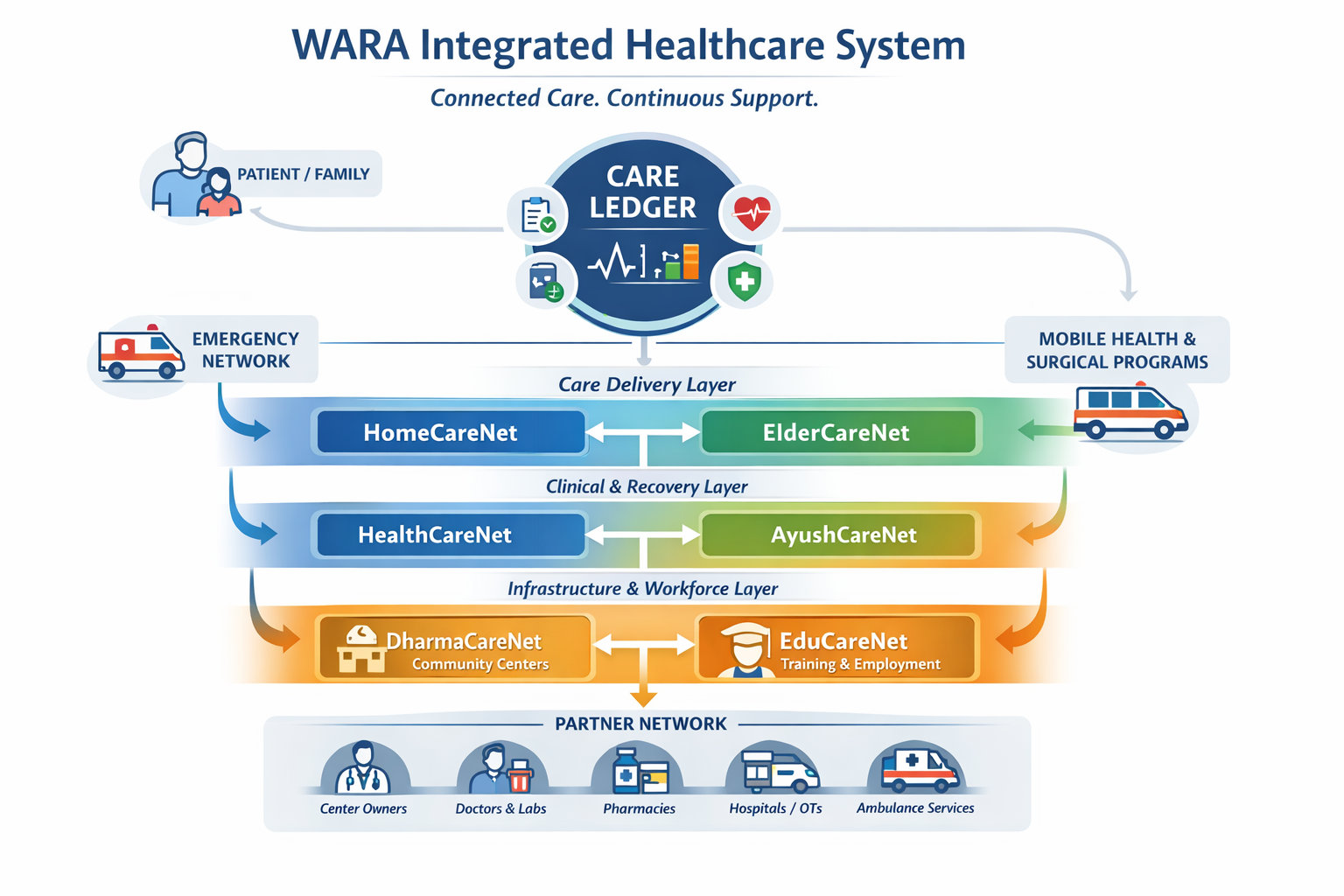
Care is not a service. It is a system.
What is the WARA System
The WARA System is a connected care infrastructure model that brings
together:
- People
- Services
- Technology
- Partners
into a single coordinated workflow.
Why a System is Necessary
Traditional care delivery often faces:
- Lack of coordination
- No visibility into daily care
- Delays in emergencies
- Fragmented services
This creates uncertainty and risk for families.
Without a system, care becomes inconsistent.
The Big Picture
WARA operates through three core layers:
1. Care Delivery Layer
👉 Direct interaction with patients
2. Clinical & Recovery Layer
- HealthCareNet
- AyushCareNet
👉 Medical access and recovery support
3. Infrastructure & Scale Layer
👉 Centers, workforce, and expansion
Each layer supports the other.
The WARA Approach
WARA solves care complexity through:
Defined Processes
- Clear step-by-step workflows
- Standard operating protocols
- Structured service delivery
Coordinated Network
- Caregivers, doctors, and partners connected
- Responsibilities clearly defined
- Communication streamlined
Real-Time Tracking
- Care Ledger records all activities
- Updates shared with families
- Transparency maintained
Structure replaces uncertainty.
How Everything Connects
👤 Patient / Family
- Entry point into the system
- Defines care requirement
🏠 HomeCareNet
- Provides caregiving at home
- Daily support
👩👧 ElderCareNet
- Monitoring
- Emergency coordination
- Reporting
🏥 HealthCareNet
- Doctor consultation
- Diagnostics
- Medical coordination
🧘 AyushCareNet
- Recovery programs
- Rehabilitation
- Wellness
🏢 DharmaCareNet
- Local center operations
- Community access
🎓 EduCareNet
- Training caregivers
- Workforce creation
All services are connected through one system.
Core System Components
Care Process
Requirement → Plan → Care → Monitoring
👉 [Explore Care Process]
Coordination Model
Defines how all roles interact
👉 [Explore Coordination Model]
📱 Care Ledger (Core Engine)
- Tracks all activities
- Maintains transparency
- Enables coordination
👉 [Explore Care Ledger]
Without tracking, there is no trust.
🚑 Emergency Response Network
- Alert → Response → Transport → Admission
- Structured and time-critical
👉 [Explore Emergency Network]
Speed + coordination = life saved.
Program Layer (Expansion Engine)
🚐 Mobile Health Program
- Community outreach
- Patient identification
👉 [Explore Mobile Health]
🏥 Surgical Access Program
- Planned procedures
- Specialist access
👉 [Explore Surgical Access]
Programs expand reach and access.
Partner Network (Execution Layer)
WARA operates through a distributed partner ecosystem:
- Center owners
- Healthcare entrepreneurs
- Labs and pharmacies
- Hospitals and OT partners
- Emergency providers
👉 [Explore Partners]
WARA does not do everything. It connects everything.
Career & Workforce Layer
The system is powered by:
- Caregivers
- Responders
- Clinical assistants
- Entrepreneurs
👉 [Explore Careers]
People are the foundation of the system.
Complete System Flow (Simplified)
Step 1: Entry
Patient enters system
Step 2: Care Delivery
HomeCareNet / ElderCareNet activated
Step 3: Clinical Support
HealthCareNet engaged
Step 4: Recovery
AyushCareNet supports
Step 5: Infrastructure
DharmaCareNet coordinates
Step 6: Workforce
EduCareNet supplies trained personnel
Continuous, connected care cycle.
Why This System Works
Integrated
No fragmented services
Transparent
Care Ledger ensures visibility
Scalable
Partner-driven expansion
Reliable
Protocol-based execution
Reliability comes from design, not effort.
What Makes WARA Unique
- System-first approach
- Not dependent on individuals
- Multi-layer coordination
- Asset-light scalable model
This is infrastructure, not just service.
Long-Term Vision
WARA aims to build:
- A nationwide care network
- A structured healthcare access system
- A scalable, technology-enabled ecosystem
A system where care is always available, always connected.
Final Thought
Most systems are built around services.
WARA is built around continuity of care.
Get Started
👉 [Get Care Now]
👉 [Explore Care Networks]
👉 [Partner With WARA]
Explore Other Pages
1 - Care Process
The WARA Care Process defines the complete journey from initial request to ongoing care delivery, monitoring, and support. It ensures structured, transparent, and reliable care through clearly defined steps and system-driven execution.
From Request to Reliable Care - Step by Step.
What is the Care Process
The Care Process is the structured journey through which WARA delivers care
to individuals and families.
It transforms:
👉 A simple request
into
👉 Continuous, monitored, and coordinated care
Care is delivered through steps, not assumptions.
Why a Defined Process Matters
Without a clear process:
- Requirements are misunderstood
- Care becomes inconsistent
- Communication gaps arise
- Families remain uncertain
A clear process builds trust from the beginning.
The WARA Care Journey
Step 1: Share Your Requirement
You begin by reaching out through:
We understand:
- Condition and care needs
- Location and schedule
- Level of support required
Every care journey starts with understanding.
Step 2: Care Plan & Recommendation
Based on your requirement, WARA provides:
- Suitable care plan
- Service scope
- Transparent pricing
The plan is designed to match:
- Care intensity
- Duration
- Type of support needed
Clarity comes before commitment.
Step 3: Caregiver Assignment
A trained caregiver is selected based on:
- Skill and experience
- Patient requirement
- Location suitability
All caregivers:
- Are trained through EduCareNet
- Follow defined protocols
- Operate within the WARA system
Right person. Right role. Right system.
Step 4: Care Begins
Care starts at home or as required:
- Daily routines executed
- Checklists followed
- Safety protocols maintained
Care delivery is structured and consistent.
Step 5: Monitoring through Care Ledger
All care activities are:
- Recorded in real-time
- Shared with families
- Tracked continuously
Families can:
- View updates
- Monitor progress
- Stay connected remotely
👉 [Learn about Care Ledger]
Visibility creates confidence.
Step 6: Coordination & Support
The system coordinates:
- Doctor consultations
- Diagnostics
- Additional services
Through:
- HealthCareNet
- DharmaCareNet centers
Care adapts as needs evolve.
Step 7: Emergency Response (if needed)
In case of emergency:
- Alert is triggered
- Response network activated
- Ambulance and hospital coordinated
👉 [Learn about Emergency Response]
Response is immediate and structured.
Step 8: Ongoing Care & Flexibility
As care needs change, WARA supports:
- Plan upgrades or changes
- Caregiver replacement
- Additional services
Care evolves with the patient.
How This Connects to the Full System
The Care Process integrates all CareNets:
- HomeCareNet → Care delivery
- ElderCareNet → Monitoring and alerts
- HealthCareNet → Clinical access
- AyushCareNet → Recovery and wellness
- DharmaCareNet → Coordination and access
- EduCareNet → Workforce supply
One process connects the entire system.
What Makes This Process Reliable
Clear Steps
- No confusion
- Easy to understand
System-Based Execution
- Defined workflows
- Standard protocols
Continuous Monitoring
- Real-time updates
- Transparent reporting
Flexible Support
Reliability comes from structure.
What This Process Does NOT Do
- Does not rely on informal arrangements
- Does not operate without tracking
- Does not leave families uninformed
It ensures:
👉 structured, visible, and coordinated care
Final Thought
Care should not begin with confusion or uncertainty.
The WARA Care Process ensures that every step is clear, connected, and
reliable from the very beginning.
Get Started
👉 [Get Care Now]
2 - Coordination Model
The WARA Coordination Model defines how caregivers, community centers, partners, and the command system work together through clearly defined roles, workflows, and communication protocols to deliver reliable and structured care.
Defined Roles. Clear Responsibility. Seamless Coordination.
What is the Coordination Model
The Coordination Model defines how the WARA system operates across people,
services, and locations.
It ensures that:
- Every role is clearly defined
- Every action follows a workflow
- Every situation is handled systematically
Care is coordinated through roles, not assumptions.
Why Coordination is Critical
Without a structured model:
- Responsibilities overlap or get missed
- Communication breaks down
- Emergencies become chaotic
- Care quality becomes inconsistent
Coordination turns multiple services into one system.
The WARA Approach
WARA uses a role-based coordination system where each participant has a
specific function.
This includes:
- Care delivery roles
- Monitoring roles
- Coordination roles
- Partner roles
Everyone knows their role. The system does the rest.
Key Roles in the System
👩⚕️ Caregiver (HomeCareNet)
Responsible for:
- Daily care delivery
- Patient support
- Routine execution
Acts as the primary point of care.
👩💼 Center Operator (DharmaCareNet)
Responsible for:
- Coordination of services
- Patient intake and routing
- Partner communication
Acts as the local system controller.
🛡️ ElderCare Associate (ElderCareNet)
Responsible for:
- Monitoring and reporting
- Emergency first response
- Family communication
Acts as the assurance and response layer.
🏥 Healthcare Partners (HealthCareNet)
Includes:
Responsible for:
- Clinical services
- Diagnostics
- Treatment
🌿 Wellness Providers (AyushCareNet)
Includes:
- Physiotherapists
- Yoga instructors
- Recovery specialists
Responsible for:
- Rehabilitation
- Lifestyle support
- Preventive wellness
🎓 Workforce System (EduCareNet)
Responsible for:
- Training caregivers
- Certification
- Deployment
Ensures continuous supply of skilled workforce.
Each role performs a specific function within the system.
How Coordination Works
Step 1: Requirement Identified
- Patient need captured
- Entered into system
Step 2: Role Assignment
- Caregiver assigned
- Center operator coordinates
- Partners engaged as needed
Step 3: Service Execution
- Care delivered
- Diagnostics conducted
- Consultations completed
Step 4: Monitoring & Tracking
- Care Ledger updated
- Status monitored
- Alerts generated if needed
Step 5: Escalation (if required)
- Issues identified
- Higher-level coordination triggered
- Emergency or clinical support activated
Coordination ensures nothing is missed.
Communication Flow
The system follows a structured communication path:
- Caregiver → Center Operator
- Center Operator → Partner Network
- System → Family (via Care Ledger)
- Alerts → Emergency Network
Communication is routed, not random.
Emergency Coordination within the Model
In emergencies:
- Alert is triggered
- ElderCare associate responds
- Center operator coordinates
- Ambulance activated
- Hospital informed
👉 [See Emergency Response Network]
Speed comes from structure.
Why This Model Works
Clear Responsibility
- No confusion in roles
- Defined accountability
Structured Workflows
- Standard steps followed
- Predictable outcomes
Scalable Design
- Same model across locations
- Easy to expand
Reduced Dependency
- Not dependent on individuals
- System ensures continuity
Systems make coordination reliable.
What This Model Does NOT Do
- Does not rely on informal communication
- Does not allow role confusion
- Does not create dependency on one person
It ensures:
👉 clarity, accountability, and reliability
Real-Life Example
A patient needs care:
- Caregiver provides daily support
- Operator coordinates doctor consultation
- Lab collects samples
- Report shared and reviewed
- Therapy planned
- Family updated
Multiple roles, one coordinated system.
Long-Term Impact
This model enables:
- Consistent service quality
- Faster response time
- Scalable operations
- Better patient outcomes
Coordination transforms services into a system.
Final Thought
Care is not delivered by individuals alone.
It is delivered by a system where every role works in harmony.
Get Started
👉 [Get Care Now]
3 - Care Ledger
The WARA Care Ledger is a real-time tracking system that records daily care activities, health updates, alerts, and coordination events. It ensures transparency, accountability, and trust between caregivers, families, and the entire care network.
Care You Can See. Trust You Can Measure.
What is the Care Ledger
The Care Ledger is WARA’s real-time tracking system for all care activities.
It records:
- Daily care tasks
- Health updates
- Alerts and incidents
- Coordination actions
Every action is recorded. Nothing is invisible.
Why the Care Ledger is Important
In traditional care:
- Families cannot see what is happening
- Care quality depends on trust alone
- Updates are irregular or delayed
- Issues are noticed too late
Lack of visibility creates uncertainty.
The WARA Approach
The Care Ledger converts care into:
- Visible
- Trackable
- Measurable
Families can:
- Monitor care remotely
- Stay informed in real time
- Make confident decisions
Trust is built through transparency.
What the Care Ledger Tracks
Daily Care Activities
- Hygiene and daily routines
- Medication reminders
- Mobility and assistance
Health Updates
- Basic vitals
- Observations and notes
- Changes in condition
Service Coordination
- Doctor consultations
- Diagnostics
- Therapy sessions
Alerts & Incidents
- Missed activities
- Health concerns
- Emergency triggers
Every detail contributes to a complete picture.
How It Works
Step 1: Data Entry
- Caregiver updates daily activities
- Operator records coordination events
Step 2: Real-Time Sync
- Information updated instantly
- System logs all actions
Step 3: Family Access
- Families receive updates
- Reports available anytime
Step 4: Monitoring & Alerts
- System identifies irregularities
- Alerts triggered when needed
The system continuously watches and records.
Who Uses the Care Ledger
Families
- Monitor care remotely
- Stay informed
- Reduce anxiety
Caregivers
- Follow structured routines
- Record activities
- Maintain accountability
Operators
- Track service flow
- Manage coordination
- Ensure quality
WARA System
- Analyze performance
- Detect risks
- Improve processes
One system connects all stakeholders.
Benefits of the Care Ledger
Transparency
- No hidden activities
- Clear visibility
Accountability
- Every action recorded
- Responsibility defined
Early Detection
- Issues identified quickly
- Preventive action possible
Better Communication
- Families stay informed
- Less dependency on calls
Visibility leads to better care.
Example Scenario
A caregiver completes daily care:
- Updates tasks in ledger
- Records vitals
- Notes a minor concern
System:
- Flags observation
- Notifies operator
Operator:
- Coordinates doctor consultation
Family:
One entry triggers the entire system.
Integration with WARA System
The Care Ledger connects with:
- HomeCareNet → daily care tracking
- ElderCareNet → monitoring and alerts
- HealthCareNet → medical coordination
- AyushCareNet → recovery tracking
- DharmaCareNet → center operations
It is the central nervous system of WARA.
What the Care Ledger Does NOT Do
- Does not replace caregivers
- Does not make medical decisions
- Does not operate independently
It supports:
👉 visibility, coordination, and control
Long-Term Vision
The Care Ledger will evolve into:
- Advanced monitoring system
- Predictive risk detection
- Data-driven care optimization
Data will improve care continuously.
Final Thought
Care should not be invisible.
The Care Ledger transforms care into something you can see, track, and trust.
Get Started
👉 [Get Care Now]
4 - Emergency Response Network
The WARA Emergency Response Network is a structured coordination system that ensures rapid response during medical emergencies through alerts, local responders, ambulance coordination, and hospital admission support.
When Every Second Matters, Systems Must Respond.
What is the Emergency Response Network
The Emergency Response Network is WARA’s structured system for handling
medical emergencies.
It ensures that when an emergency occurs:
- Response is immediate
- Coordination is automatic
- Action is structured
Emergencies are unpredictable. Response should not be.
Why This System is Critical
In most real-life situations:
- People panic
- Decisions are delayed
- Ambulances are not coordinated
- Hospitals are not prepared
Delay is the biggest risk in emergencies.
The WARA Approach
WARA replaces panic with a predefined response system:
- Pre-linked hospitals
- Pre-coordinated ambulance network
- Defined response roles
- Real-time alerts
Prepared systems save time. Time saves lives.
How the Emergency System Works
Step 1: Alert Triggered
An alert is generated through:
- Caregiver
- Family
- System (via Care Ledger)
The system is always ready to respond.
- Nearest ElderCare associate is alerted
- She reaches the patient location
- Provides initial support and coordination
First response is local and fast.
Step 3: Ambulance Activation
- Pre-connected ambulance network alerted
- Closest available vehicle assigned
- Pickup coordinated quickly
Transport is not searched - it is activated.
Step 4: Hospital Coordination
- Predefined hospital informed
- Admission process prepared
- Insurance and patient details shared
Hospitals are ready before arrival.
Step 5: Continuous Monitoring
- Status tracked in real-time
- Family updated continuously
- Coordination maintained until admission
Communication remains uninterrupted.
Key Components of the Network
Local Responders
- Trained ElderCare associates
- Rapid on-ground coordination
Ambulance Network
- Pre-verified partners
- Route-based availability
Hospital Network
- Pre-identified hospitals
- Admission-ready coordination
Command & Coordination System
- Central workflow control
- Structured communication
- Real-time updates
Each component plays a critical role.
Why This System Works
Predefined Flow
- No decision-making delay
- Clear sequence of actions
Local + Network Response
- Fast local reach
- Strong backend support
Integrated Communication
- Everyone informed
- No confusion
System-Based Execution
- Not dependent on individuals
- Works consistently
Structure ensures speed.
What Families Experience
- Immediate response
- Continuous updates
- Reduced panic
- Better control of situation
Confidence replaces fear.
Real-Life Scenario
An elderly patient faces a sudden issue:
- Caregiver triggers alert
- Local responder reaches within minutes
- Ambulance activated automatically
- Hospital informed and prepared
- Patient admitted without delay
- Family receives updates throughout
Every step is coordinated.
What This System Does NOT Do
- Does not replace hospitals
- Does not provide medical treatment
- Does not operate without predefined agreements
It ensures:
👉 fast, structured, and coordinated response
Integration with WARA System
This network connects with:
- ElderCareNet → responders
- DharmaCareNet → coordination
- HealthCareNet → hospitals
- Care Ledger → alerts and tracking
It is part of the complete care system.
Long-Term Vision
The Emergency Network aims to:
- Reduce response time significantly
- Improve survival outcomes
- Build reliable emergency infrastructure
Faster response leads to better outcomes.
Final Thought
In emergencies, time is everything.
The WARA Emergency Response Network ensures that no time is lost between need
and action.
Get Started
👉 [Get Care Now]
5 - Surgical Access Program
The WARA Surgical Access Program enables planned surgeries through structured coordination between specialist doctors, partner hospitals, and local care systems. It improves access to quality surgical care without building new infrastructure.
Specialist Care. Brought Closer.
What is the Surgical Access Program
The Surgical Access Program is a structured system to enable planned
surgeries by connecting:
- Specialist doctors
- Partner hospitals
- Local care networks
It focuses on:
- Scheduled surgical camps
- Coordinated procedures
- System-driven execution
Access to surgery should not depend on geography.
Why This Program is Needed
In many regions:
- Specialist doctors are not available locally
- Patients must travel long distances
- Government hospital infrastructure is underutilized
- Surgeries are delayed or avoided
The gap is not infrastructure - it is access to specialists.
The WARA Approach
WARA enables:
Bringing Specialists to Where Patients Are
Instead of moving patients to cities:
- Specialists travel to partner hospitals
- Surgeries are scheduled in batches
- Infrastructure is utilized efficiently
Access is created by coordination, not construction.
How the Program Works
Step 1: Patient Identification
Patients are identified through:
- DharmaCareNet centers
- Mobile Health Programs
- Community outreach
Step 2: Diagnosis & Evaluation
- Consultation conducted
- Diagnostics completed
- Surgery requirement confirmed
Step 3: Surgery Planning
- Cases grouped based on type
- Surgery day scheduled
- Hospital and resources aligned
Step 4: Specialist Deployment
- Visiting surgeons arrive with team
- Operate at partner hospital facility
Step 5: Surgical Execution
- Multiple procedures conducted in a planned session
- Hospital staff supports operations
Step 6: Post-Surgery Care
- Recovery coordinated through HomeCareNet
- Rehabilitation supported by AyushCareNet
The entire journey is coordinated end-to-end.
Key Components of the Program
Partner Hospitals
- Government or private hospitals
- Provide infrastructure and staff
Specialist Doctors
- Visiting surgeons
- Perform scheduled procedures
Local Network (DharmaCareNet)
- Patient coordination
- Scheduling and preparation
Care System Integration
- Pre and post care support
- Monitoring and follow-up
Each component plays a defined role.
Types of Surgeries Supported
- Cataract surgeries
- Minor and medium procedures
- Elective surgeries
- Community-focused health interventions
Focus is on high-impact, scalable procedures.
Benefits of the Program
For Patients
- Access to specialists locally
- Reduced travel and cost
- Faster treatment
For Hospitals
- Better utilization of infrastructure
- Increased service efficiency
For Doctors
- Organized surgical sessions
- Ability to serve underserved areas
For Communities
- Improved healthcare access
- Reduced untreated conditions
Everyone benefits from coordination.
Why This Model Works
Uses Existing Infrastructure
- No need to build new hospitals
- Efficient utilization
Batch-Based Efficiency
- Multiple surgeries in one session
- Better resource use
System Coordination
- Clear workflows
- Defined responsibilities
Efficiency improves access.
Legal & Compliance Approach
The program operates through:
- Formal agreements with partner hospitals
- Licensed and qualified doctors
- Compliance with healthcare regulations
All services follow legal and ethical standards.
What This Program Does NOT Do
- Does not operate independent surgical facilities
- Does not bypass hospital systems
- Does not perform unauthorized procedures
It ensures:
👉 structured access within existing frameworks
Integration with WARA System
This program connects with:
- HealthCareNet → diagnosis and referral
- DharmaCareNet → coordination
- HomeCareNet → post-care support
- AyushCareNet → recovery and rehabilitation
It is part of a continuous care system.
Long-Term Vision
The Surgical Access Program aims to:
- Expand specialist access nationwide
- Reduce untreated surgical conditions
- Utilize public healthcare infrastructure efficiently
Access to surgery should be universal.
Final Thought
Specialist care should not be limited to cities.
WARA brings surgical access closer to communities through coordination,
planning, and system-driven execution.
Get Started
👉 [Get Care Now]
6 - Mobile Health Program
The WARA Mobile Health Program delivers basic healthcare access, screening, and awareness services to remote and underserved communities through mobile units. It connects individuals to the WARA care system and enables early detection, treatment, and recruitment into the care network.
Reaching Where Care Cannot.
What is the Mobile Health Program
The Mobile Health Program is WARA’s outreach system that brings basic
healthcare services directly to communities.
It uses:
- Mobile units
- Basic diagnostic tools
- Trained field teams
Care should reach people, not wait for them.
Why This Program is Needed
In many regions:
- Healthcare access is limited
- Awareness is low
- Conditions go undiagnosed
- Travel to hospitals is difficult
Delay in detection leads to serious health issues.
The WARA Approach
WARA takes care to the field through:
Mobile Screening & Registration
- Basic health checks
- Patient identification
- Digital record creation
System Integration
- Patients connected to WARA network
- Follow-up coordinated through centers
- Long-term care initiated
Outreach becomes the entry point into structured care.
How the Program Works
Step 1: Area Identification
- Remote or underserved locations selected
- Community needs assessed
Step 2: Camp Setup
- Mobile unit deployed
- Temporary screening setup arranged
Step 3: Screening & Registration
- Basic health checks conducted
- Individuals registered in system
- Risk cases identified
Step 4: Referral & Follow-Up
- Cases routed to:
- Community Centers (DharmaCareNet)
- Doctors (HealthCareNet)
- Care services (HomeCareNet)
Step 5: Program Continuation
- Regular visits scheduled
- Follow-up tracking ensured
- Community engagement maintained
Screening leads to structured care.
Services Delivered
Basic Health Screening
- Blood pressure
- Blood sugar
- Vision screening
- General assessment
Awareness & Education
- Preventive health guidance
- Lifestyle awareness
- Early symptom recognition
Patient Registration
- Digital entry into system
- Care tracking initiation
Referral Coordination
- Doctor consultations
- Diagnostics
- Surgical programs
It combines detection with action.
Key Use Cases
Cataract Identification Programs
- Vision screening
- Surgery planning through Surgical Access Program
Chronic Disease Detection
- Early identification
- Lifestyle and care support
Maternal & Basic Health Awareness
- Community-level education
- Early risk detection
Elder Health Programs
- Routine screening
- Engagement and support
Focus is on high-impact community needs.
Recruitment & Workforce Impact
Mobile programs also help:
- Identify local women volunteers
- Engage potential caregivers
- Introduce EduCareNet opportunities
Outreach builds both demand and supply.
Integration with WARA System
This program connects with:
- DharmaCareNet → local follow-up
- HealthCareNet → consultations and diagnosis
- HomeCareNet → caregiver deployment
- AyushCareNet → recovery and wellness
- EduCareNet → training and recruitment
It feeds the entire care ecosystem.
Benefits of the Program
For Communities
- Improved healthcare access
- Early detection of conditions
- Increased awareness
For Patients
- Reduced delay in treatment
- Easier entry into care system
- Better health outcomes
For WARA
- Demand generation
- Network expansion
- Community trust building
Outreach creates long-term impact.
Role in CSR & Partnerships
The Mobile Health Program enables:
- CSR-funded health camps
- NGO collaboration
- Government partnerships
Programs can be:
- Sponsored
- Scaled regionally
- Impact-measured
Social impact meets structured execution.
What This Program Does NOT Do
- Does not replace hospitals
- Does not provide advanced treatment
- Does not operate without follow-up
It focuses on:
👉 screening, awareness, and system entry
Long-Term Vision
The program aims to:
- Reach underserved populations
- Reduce undiagnosed conditions
- Build a connected care network from the ground up
Every outreach expands the system.
Final Thought
Care should not be limited by location.
The Mobile Health Program ensures that even the most remote communities are
connected to structured, reliable care.
Get Started
👉 [Partner With WARA]